Measurement tells you how you did. Learning tells you how to do better next time, and most marketing organisations are far more practised at the first than the second. In a data-rich world the shortage is rarely data and almost always focus. Every team I've worked with has had more dashboards than decisions, and more open questions than anyone could reasonably answer in a year.
Learning agendas are meant to fix that, by pointing a team's curiosity at the questions that matter. In practice they tend to sprawl until they quietly become a list of things someone once thought would be interesting. Marketing mix models are often held up as the cure, and they're excellent at some questions and poor at others. When people realise a model can't settle everything, the follow-up is usually the same: how do you keep learning focused enough to be useful?
Where this comes from
Early in my career I worked in innovation consulting in Oslo, alongside a team that had developed a stage-gate framework for product innovation. An idea only moved forward once it had passed a gate, and each gate asked a hard question about whether the idea still deserved time and money. Most ideas didn't make it through, which was rather the point.
Over the years I've adapted that framework for learning agendas, because learning and innovation share a critical trait. Both thrive when curiosity is held in check by discipline, and both fall apart when one is allowed to run without the other.
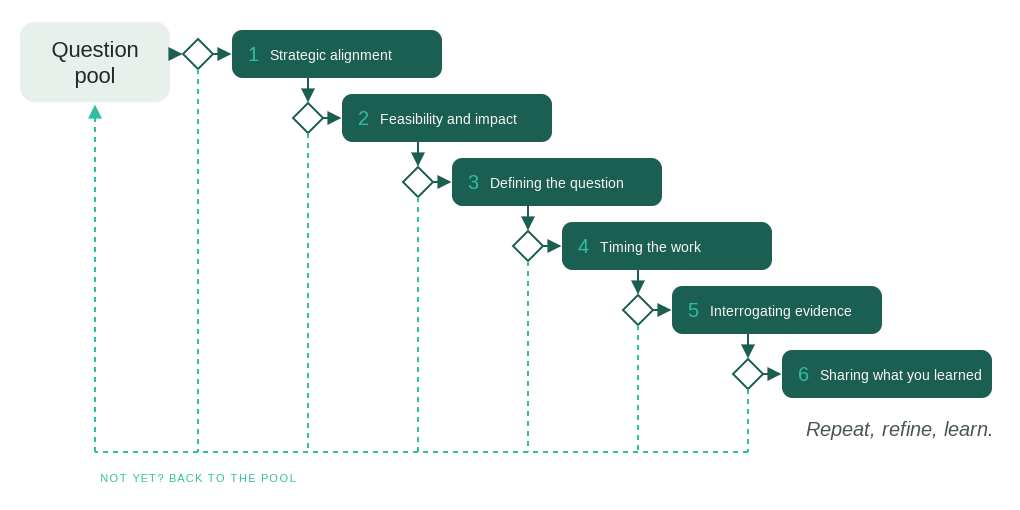
The most important feature of the framework is what happens when a question fails a gate. It goes back into the pool, usually with a clearer idea of what it needs before it's ready. Questions that fail early are being sharpened, which makes the whole thing a cycle rather than a funnel.
Before the first gate
Two pieces of groundwork make the gates work far better.
The first is an audit of what the organisation already knows. Staff turnover and siloed teams mean companies regularly pay to research questions they answered years ago, with the original report sitting unread in someone's old folder. Going back through the last few years of research and walking the relevant teams through what it found is unglamorous work. It also tends to answer a surprising share of the agenda before any new work begins.
The second is a set of question workshops, designed to draw out what people actually want to know. The biggest barrier to asking good questions inside a company is self-consciousness, so the format matters more than you'd expect. I keep groups to five people at most, so nobody feels sidelined, and I avoid putting rival channel teams in the same room, because the session should never become a contest. An hour is plenty, with about twenty minutes of setting the scene and the rest guided discussion. Questions are submitted anonymously, which is often what finally gets someone to ask whether a long-standing mandate actually works.
Gate 1: Strategic alignment
Anchor every learning effort to the company's strategic goals. A surprising number of learning agendas are full of questions nobody upstairs ever asked, and the answers arrive to polite interest and no change whatsoever.
The test I use is blunt. If we answered this question tomorrow, which decision would change, and who makes it? Tying questions to the organisation's stated objectives, its OKRs where they exist, keeps the agenda pointed at what matters right now and puts real accountability on the team doing the learning.
Gate 2: Feasibility and impact
Not every question is worth pursuing, even the aligned ones. I plot each candidate on a simple grid, with potential business impact on one axis and feasibility on the other, and the shape of the agenda usually becomes obvious at a glance.
High-impact, highly feasible questions go first. High-impact questions that can't yet be answered get their own column, marked long term, so they're parked deliberately and never quietly abandoned. Low-impact questions can wait, however interesting they are.
Gate 3: Defining the question
Frame every query the way a scientist would, as a testable hypothesis. The most common pitfall I see is a team that runs an analysis without ever agreeing what it expected to find. Every analyst has lived through the exchange that follows: "What did you find out?" "Well, what were you hoping to find?"
I use a short template for each question, covering the question itself, the objective behind it, the method, how success will be measured, and who's responsible for the work and for acting on the result. It takes ten minutes to fill in and saves weeks of arguing about what the findings mean.
This is also the gate where the biggest gains tend to hide. In pharma, the standard question was which doctors prescribe the most. Reframing it as which doctors are changing their prescribing, and in which direction, led to a model that found the declines a volume ranking could never see. The data was the same in both cases, and only the question had changed.
Gate 4: Timing the work
Timing is everything. Most learning needs real market data, so it has to be planned alongside the marketing calendar, and an answer that arrives a month after budgets are set has become trivia. Working backwards from the decision tells you when the work has to start.
Laying out a full learning calendar also exposes a quieter bias. Digital channels are easier to test, so they fill the calendar first, while television and outdoor go largely unexamined. It's worth leaning deliberately against that, because the channels that are hardest to measure are often the ones carrying the biggest assumptions.
Gate 5: Interrogating the evidence
Don't cherry-pick data to fit the narrative. Before anything is published, check that the test ran the way the hypothesis said it would, and if it didn't, ask honestly whether the findings can still be relied on. Treat every result with the same seriousness, whether it validates your thinking or challenges it.
The quieter danger here is a new metric that looks too good. When we first had the ability to tie McDonald's Canada's ads to store visits, there was real pressure to start targeting the people most likely to visit. Without historic data, we couldn't tell whether an ad had prompted a visit or simply reached someone already on their way, and optimising towards the measure would have rewarded the latter. We used it to measure effectiveness and kept it well away from targeting, which is the main reason the results we later reported could be trusted.
Gate 6: Sharing what you've learned
Learning only becomes useful when it's shared. An insight that lives in one analyst's slide deck has a half-life of about a quarter, so keep a running record of questions asked, answers found and decisions changed, and make sure it reaches the people who make those decisions.
Shared learning also changes how recommendations sound. "I recommend this new ad format to increase reach" is a sales pitch. A recommendation framed around the client's own objective, with a clear test of whether it deserves more investment, is advice. The difference is entirely down to what's been learned and remembered along the way.
Repeat, refine, learn
Every answer raises new questions, and those go back through the same six gates. Over time the questions get sharper and the organisation builds a habit of learning on purpose instead of by accident. That habit, more than any single finding, is what keeps a team ahead when yesterday's tactics stop working.
Business learning is nuanced, and no framework covers every case. If you're consistently putting your initiatives through these six gates, though, you're very likely on the right track. I'd be curious which one you find hardest to hold.