We're doing it again
If you've been in marketing long enough, this moment feels familiar. There's a creeping groundhog day sensation to it, even if you can't quite name why.
In my last article I outlined the changes marketing has experienced over the last 20 years, and the influx of capabilities we have acquired. Every one of them seemed to arrive with a team, its own metric, and its own accommodations in the brief. The answer to what the brand is still exists somewhere upstream. It's just that now it gets sanded down through layers of activation, each with its own interpretation of the brief, then ground down further by platform and user optimisation, until what finally reaches a customer is a homogeneous blur rather than the unified brand you started with.
What I papered over was how we adapted to those capabilities as they arrived. What we did was very human, we took our reality at the time and applied it to each new capability. Brochures became websites, fairly literally, without real consideration for the browsing experience or even the intent of the user. TV ads became digital placements, despite having a fraction of the attention window. Remember when we shoved 30 second ads onto Facebook? It took years of awkward implementation before we worked out what made each medium come to life.
Hindsight makes these easy to spot, yet it's fairly evident we're making similar mistakes. We're bolting chatbots onto sites without changing how those sites serve information. We're using LLMs to make more of what we already make rather than to make something different. We're applying keyword SEO logic to a system that describes us rather than ranks us. The old model at scale is the soundtrack, but nobody seems to notice that the dance has changed and we're all a bit out of step.
The first thing most organisations have done with these tools is speed up production. Speed and scale don't help a brand that's already been sanded down, they just distribute it faster than anyone can review it. Generating ten thousand variations within a flawed system is industrialised mediocrity.
So the question we should be asking now isn't what we can do to accelerate, it's what we can do to make this latest step change in capabilities less bumpy than the last one.
To avoid the same bumps this time, it's worth outlining what each era actually asked of a brand.
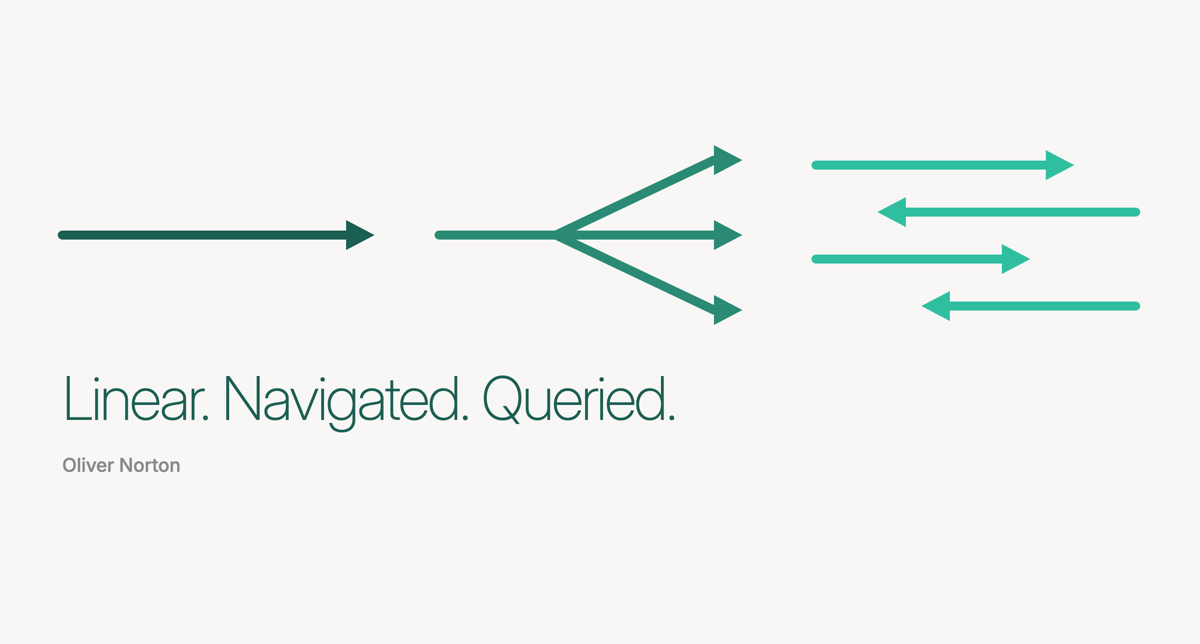
Linear: mass broadcast, OOH, print. One way, interruption based. Brands authored a script, one message, one treatment.
Navigated: search, web, social. Brands authored multiple navigable paths, still controlled, just with options.
Queried: conversational, retrieval based discovery. There are too many possible answers to write in advance, so brands author the personality and the knowledge base that produce them.
It's not slogans and brand treatments any more, it's personalities and knowledge bases.
The navigated era rewarded being found. The queried era will reward being understood accurately, represented richly, and then, the harder step, recommended. You can dominate search rankings and be close to invisible in conversational retrieval, and conflating those two problems is expensive.
What's actually happening
The transition from linear marketing to the navigated world we know today seemed almost instantaneous, but in reality it was much slower than we likely remember, as hardware adoption and digital behaviours caught up over the best part of a decade. The change to the queried world is happening far more rapidly. NielsenIQ found in May that 42% of US consumers had used an AI tool to shop in the past month. You would struggle to see any of that in your own analytics though, because Bain's work with Similarweb puts AI at less than one percent of most retailers' total traffic. The research is happening on the platform, so most of the journey never touches you at all.
You don't have to try hard to see why. Pick a brand with a web presence you think is best in class. Then try prompting a model to read it, chances are it will be either blocked or barely legible to it. In my testing the model mostly reached for editorial roundups, magazine reviews and forum threads, assembled an approximation, and failed when I asked about product specifics. The information exists on that site, obviously. It just isn't reachable in the way a live query needs.
What arrives from a model, though, is a different kind of visit. Adobe found across more than a trillion visits that traffic from AI sources converts 54% better than traffic from anywhere else, spends 53% longer on site and browses 23% more pages. That looks less like a visit to decide and more like a visit to verify.
The trust data points the same way, though it's about retailers rather than brands. Asked who they'd trust to handle the whole shopping experience, one in four US shoppers picked retailers, against 16% for a technology company like Google and 7% for an AI platform like ChatGPT. A quarter isn't a majority, and a retailer isn't a brand. What it suggests is that proximity to the source carries a premium over the generalist intermediary, and there's no obvious reason that would hold for a retailer and not for a brand. People are happy to let a model do the work, and then they want to check it against somebody they believe. Your site is where that check happens.
A brand can be doing everything the navigated era rewards, a beautiful website, a strong SEO strategy, hard-won search visibility, and still be losing ground now that the queried era is arriving. They just can't see it in their attribution data yet.
What needs to change
I think there are four areas worth focusing on if we want to traverse this transition better than we did the last one.
First, the brand has to know what it is, explicitly, and in a form both people and machines can adopt. Not the implicit understanding held by a few senior people, and not the brand book ageing on a shared drive. A single written record of what the brand exists for, who it is when it shows up, what it says, what it refuses to say, the evidence behind every claim, and what its personality is when speaking. Writing it down isn't enough on its own though. We need tools and ways of working that check the work against this identity, before publication and continuously across everything already live, so that drift can be caught while it's still small. A guardrail rather than a gate, that will prevent the acceleration to the homogeneous blur.
Second, our data has to be structured so it can be queried rather than simply navigated. This is a separate problem from the first. The record will define what's true, but we need to ensure the data can actually be reached. Product information, specifications, availability, editorial, all of it needs to be structured at the source and accessible independently of the page it happens to sit on. It also needs the depth and elaboration to answer questions we haven't written pages for. A data architecture that allows external models to understand the brand directly also allows our own experiences to assemble an answer around a customer's question, rather than forcing them through a journey we've designed in advance. Before the experience can become queried, the architecture underneath it has to be queryable.
Third, we should build for conversation rather than bolt it onto navigation. The chat agent tucked into the corner of a conventional website is probably our equivalent of turning the brochure into a webpage. A queried experience lets somebody explain what they want in their own language, then assembles the relevant experience around them from the architecture underneath. Navigation won't disappear, sometimes a menu is simply better, but it stops being the only way a customer can engage. Building that experience today isn't cheap, but people are already arriving at brand websites to verify conversations they've had elsewhere, only to land back in a navigated experience. We should be looking to let them continue that conversation with the brand itself.
Fourth, we need to take conversational signal seriously. The navigated era gave us behavioural surveillance, intent inferred from clicks, session paths and attribution models, so we watched what people did and guessed at what they were thinking. A conversation gives you the thing itself: what somebody actually asked, how it developed, where curiosity deepened or dropped away, what language they used when they were genuinely interested rather than politely browsing. Over the next decade I think understanding that will become one of the more valuable capabilities a marketing function has. It compounds with the other three too. Brands that own their conversational surfaces accumulate it directly, and when agent placements do start appearing on other people's platforms, the ones that already understand how their audience talks to them will be the ones able to show up as themselves.
The honest caveats
We're early, and plenty of this will hit snags or dead ends. Right now it's very difficult to get a model to describe a brand exactly the way you'd want against a given query. Nesting retrieval data in your own language, with use cases, competitive framing and reasons to believe, gets you closer slowly rather than quickly.
I've also laid out three eras as though they're discrete, and they aren't. Linear advertising is still the majority of global ad spend, the navigated era isn't over, and the queried one is ascendant without having replaced anything. The future is an amalgam, and anybody telling you the queried era has arrived in full is selling something.
Nobody has worked out conversational register properly either, including the brands furthest along. The ones that learn to speak naturally in dialogue rather than broadcasting in chat will feel human, and most of us are still guessing at how.
The close
Most people are shoehorning AI into today's world when the bigger opportunity is building a new one. The brands that built for the navigated era on its own terms dominated the decade that followed.
I ended my last article saying that identity and alignment still work, and that what we're missing is a mechanism for holding onto them. There is one here, but the opportunity is bigger than that. Building for the queried era requires brand thinking, data architecture and a real understanding of how customers engage, and those three rarely live in the same space. Bringing them together doesn't just help preserve the brand as AI scales, it changes how that brand can be understood and experienced.
The companies that manage to bring those disciplines together won't simply be better prepared for AI. They'll have built a more direct relationship with the people they serve.